
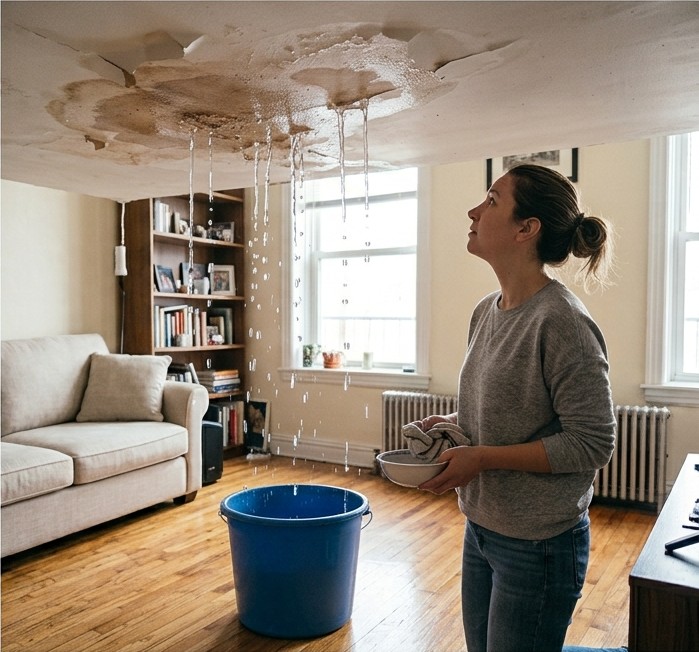
You wake to a sound you do not recognize. First, a drip. Then a rush.
Water is coming through your ceiling, pooling on the floor and soaking into the baseboards you refinished last spring.
Your first thought is probably, “the unit above me caused this. They should pay for it.”
It seems obvious. But in a strata building, the fact that water came from another unit does not automatically make that owner responsible.
When a pipe bursts or a unit floods, responsibility can depend on where the failure occurred, what your strata’s bylaws say, and whether anyone was negligent. The difference matters because the party responsible for fixing the building may not be the same party responsible for paying for the damage inside your home.
Who Is Responsible When Water Comes from the Unit Above?
The starting point is not the unit above you. It is the source of the water.
In a strata building, responsibility is generally divided between the strata corporation and individual owners. The key question is whether the failed component is common property or part of a strata lot.
Common property can include parts of the building’s structure and pipes or services that serve the building. If a pipe inside a common wall fails, for example, the strata corporation may have responsibility for repairing that pipe and maintaining the common property.
By contrast, fixtures and appliances within an individual unit may fall under the owner’s responsibility. A leaking toilet, washing machine or faucet can raise very different questions from a pipe that fails inside a shared wall.
Does the Strata Corporation Always Pay for Pipe Bursts?
The Strata Property Act sets out general responsibilities for repairing and maintaining common property, but the specific circumstances of a water damage claim still matter. Your strata’s bylaws can also affect how certain repair and maintenance responsibilities and costs are allocated.
For example, imagine two Vancouver strata buildings experience the same type of leak from a pipe.
In one building, the relevant pipe may clearly fall within the strata corporation’s repair obligations. In another, the bylaws may affect how certain costs are allocated to an owner.
The buildings could be only a few blocks apart, yet the financial outcome could be different.
That is why your strata plan and bylaws are essential documents in any water damage dispute.
If the strata tells you that you are responsible for a repair or a large bill, do not rely solely on what another owner experienced in a different building. The answer depends on the documents governing your strata.
What If the Strata Says You Are Responsible Even Though You Were Not Negligent?
This is where strata water damage disputes can become more complicated.
Many owners assume that they can only be held responsible if they did something wrong. But under the Strata Property Act, the concept of being “responsible” for a loss can extend beyond ordinary negligence, depending on the circumstances and the applicable bylaws.
That means an owner can sometimes face a claim even when they believe they acted reasonably.
However, receiving a demand from the strata does not mean the amount claimed is automatically owed.
The strata still need a proper basis for its position. There may be questions about:
- Where the water originated
- Whether the failed component was common property or part of the strata lot
- What the bylaws require
- Whether the owner was responsible for the loss
- Whether negligence is relevant under the applicable bylaws
- Whether the amount being claimed is properly supported
This is why it is important to review the source of the leak, the strata plan, the bylaws and the evidence together, rather than treating the strata’s demand as the final answer.
What Should You Do After Water Damage in a Strata?
The first few steps can make a significant difference if the situation later becomes a legal dispute.
-
Report the leak to the strata
Notify the strata as soon as possible and do it in writing. If there is an emergency, deal with the immediate risk first, but create a written record as soon as you can.
-
Document the damage
Take photographs and videos of the water, damaged flooring, walls, ceilings, baseboards, furniture and personal belongings.
If possible, document the apparent source before remediation or repairs alter the area.
-
Keep your records
Save emails, letters, inspection reports, invoices, restoration records and repair estimates. These documents can help establish what happened and what the resulting costs were.
-
Be careful about accepting responsibility
If the source of the leak has not been established, avoid making statements that could later be interpreted as an admission that you caused the damage.
The same applies if the strata ask you to sign a release, settlement or agreement concerning the repairs or costs.
-
Get advice if the positions harden
Legal advice can be particularly useful when the strata demand payment, refuses to repair common property, disputes the source of the leak, or asks you to accept responsibility for significant costs.
How Hoogbruin & Company’s Strata Litigation Lawyer in Vancouver Can Help Vancouver Strata Owners
Strata disputes are stressful under the best of circumstances. When your home is damaged, the responsible party is contested, and the strata council sees things differently, the stakes are real.
Hoogbruin & Company has acted for clients in real estate and strata matters throughout British Columbia since 1987, from our office at 1166 Alberni Street in downtown Vancouver. We act on both sides of these disputes, advising individual owners and tenants as well as strata corporations and councils. Acting for both means we know how the other side builds its position, and what a weak one looks like.
When an owner comes to us after water damage, the work usually looks like this:
- Reading your strata plan and bylaws to establish where responsibility sits
- Assessing a demand made against you, and responding to it on your behalf
- Pressing a strata corporation that is refusing to carry out repairs it owes
- Building the evidence needed to establish, or to defend against, an allegation of negligence
- Representing you at the Civil Resolution Tribunal or in the Supreme Court of British Columbia
Our role is to make the law make sense, and to make sure you understand your position clearly enough to decide what comes next with confidence.
Facing a strata water damage dispute in Vancouver? Contact Hoogbruin & Company to arrange a consultation, or call 604-609-3783. Bring your bylaws and any correspondence from the strata, and we will walk through your options in plain language.
Frequently Asked Questions About Strata Water Damage in Vancouver
Who is responsible for water damage in a strata in British Columbia?
It depends on where the failure occurred and what the bylaws say. If the source was common property, such as a pipe inside a wall, the strata corporation is generally responsible. If the source was a fixture inside a unit, such as a tap or an appliance, responsibility usually sits with that owner. Carelessness by any party can change the outcome.
Is the owner of the unit above me automatically liable for flooding my condo?
There is no automatic liability in British Columbia simply because water came from above. Responsibility depends on the source of the failure, the strata’s bylaws, and whether the owner above acted unreasonably.
Can my strata hold me responsible even if I was not negligent?
The Strata Property Act allows a strata corporation to pursue an owner who is responsible for a loss, and British Columbia decisions have interpreted responsibility more broadly than negligence. Some bylaws limit this to cases of negligence, so your building’s bylaws need to be reviewed before you pay anything.
What can I do if my strata refuses to repair common property?
The duty to repair and maintain common property is a legal obligation. An owner can seek orders requiring the strata to meet it, and further remedies exist where a strata treats an owner in a way that is significantly unfair. Building a written record of your requests and their responses is the practical first step.
What should I do in the first 48 hours after a leak?
Report it to the strata in writing, photograph and video the damage and its source before remediation begins, keep every receipt, and avoid accepting responsibility or signing anything until you understand your position.
Where are strata water damage disputes heard in British Columbia?
Most are resolved through the Civil Resolution Tribunal, though some matters proceed in the Supreme Court of British Columbia depending on the claim and the amount involved.
Do I need a lawyer for a strata water damage dispute?
Not for every incident. Legal advice becomes valuable when a demand is made against you, when the strata refuse to carry out repairs it owes, or when the amount at stake is significant enough to justify having your position properly assessed.